
IP Camera vs Analog Camera: Which CCTV Is Better?
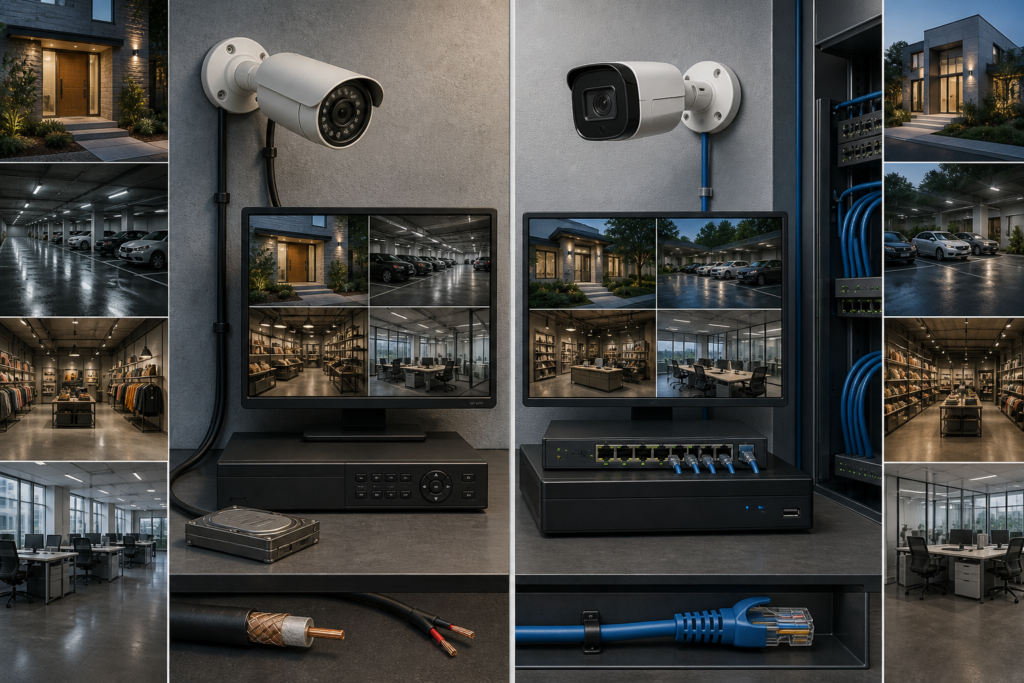
IP Camera vs Analog Camera: Which CCTV Camera Is Better?
Choosing the right CCTV camera can be confusing, especially when you have to decide between an IP camera and an analog CCTV camera. Both technologies are widely used for home security, shops, offices, societies and commercial properties, but they work differently and offer different advantages.
If you are planning a new CCTV installation or upgrading an existing surveillance system, understanding the difference between IP CCTV and analog CCTV can help you choose a system that matches your property, budget and security requirements.
In this guide, BetterSupport explains the key differences between IP and analog cameras, including image quality, cabling, installation, networking, storage, remote monitoring, scalability and overall suitability.
What Is an Analog CCTV Camera?
An analog CCTV camera is a traditional surveillance camera that sends video signals through coaxial cable to a DVR (Digital Video Recorder).
A typical analog CCTV setup includes:
- Analog CCTV cameras
- Coaxial cable
- DVR
- Hard disk
- Power supply
- BNC connectors
- Network connection for remote viewing
Analog CCTV systems have been used for many years and remain a practical option for many homes, shops and small businesses.
What Is an IP Camera?
An IP camera (Internet Protocol camera) is a network-based CCTV camera that sends video over a computer network.
Instead of sending a traditional analog video signal to a DVR, an IP camera communicates through a network and is commonly connected to an NVR (Network Video Recorder) or compatible network storage system.
A typical IP CCTV system may include:
- IP cameras
- NVR
- PoE switch or PoE NVR
- Cat5e/Cat6 network cable
- Hard disk
- Network router or switch
- Internet connection for remote access
IP Camera vs Analog Camera: Quick Comparison
| Feature | IP Camera | Analog Camera |
|---|---|---|
| Technology | Network-based | Traditional video signal |
| Recorder | NVR | DVR |
| Cable | Cat5e/Cat6 network cable | Usually coaxial cable |
| Power | Can use PoE in compatible systems | Usually separate power connection |
| Networking | Built into the system | Network is generally added for remote access |
| Expansion | Flexible depending on network design | Depends on DVR channels and cabling |
| Installation | Requires network planning | Generally straightforward for traditional setups |
| Best suited for | Modern homes, offices and larger installations | Homes, shops and budget-focused installations |
1. Image Quality
One of the biggest considerations when comparing IP and analog CCTV is image quality.
Modern IP cameras can provide high-resolution video and advanced imaging features. Depending on the model, they can offer detailed footage that can be useful for identifying faces, vehicles, objects and other important details.
Modern analog HD technologies can also provide high-resolution video, so the difference should not be judged only by the word “analog” or “IP”. The actual camera model, resolution, lens, sensor, lighting and installation quality all matter.
2. Cabling Difference
Traditional analog CCTV systems commonly use coaxial cable for video transmission, while IP cameras generally use network cable such as Cat5e or Cat6.
IP systems can also use PoE (Power over Ethernet), allowing compatible network cables to carry both data and power to the camera.
This can simplify installation, particularly when multiple cameras are being installed in an organized network infrastructure.
3. Installation
Both systems require proper planning and professional installation.
For analog CCTV, the installer typically runs coaxial cable from each camera to the DVR along with the required power connections.
For an IP CCTV system, the installer needs to plan the network, IP addressing, switches, PoE requirements and NVR connectivity.
For larger installations, proper network planning becomes particularly important for maintaining reliable CCTV performance.
4. Remote Mobile Viewing
Both modern IP and analog CCTV systems can support remote viewing when the DVR/NVR and network are configured correctly.
This means you can potentially view compatible CCTV cameras from a smartphone or computer while away from the property.
The actual remote-viewing experience depends on the camera/recorder manufacturer, internet connection, network configuration and mobile application.
5. Storage
Both IP and analog CCTV systems can use hard disks for recording.
Storage requirements depend on factors such as:
- Number of cameras
- Camera resolution
- Frame rate
- Compression technology
- Recording schedule
- Motion-based recording
- Required retention period
A professional CCTV installer can help calculate suitable storage based on your recording requirements.
6. Scalability and Future Expansion
If you expect your CCTV system to grow over time, planning the system architecture from the beginning is important.
IP CCTV can be particularly useful for network-based installations where additional cameras, switches and network infrastructure can be planned as the system expands.
However, the actual expansion capacity depends on the NVR, network design, available bandwidth and other equipment.
7. Advanced Features
Many modern IP cameras are available with advanced features depending on the model and manufacturer.
These may include:
- Motion detection
- People detection
- Vehicle detection
- Smart event detection
- Two-way audio
- Color night vision
- Wide Dynamic Range
- Remote monitoring
- Edge storage
Some modern analog HD cameras also provide advanced features, so it is important to compare the actual specifications rather than choosing a system based only on the technology type.
8. Cost: IP Camera vs Analog Camera
The total CCTV cost depends on much more than the camera price.
You should consider:
- Camera cost
- DVR/NVR cost
- Hard disk
- Cabling
- Power supply
- PoE switches where required
- Network equipment
- Installation charges
- Maintenance requirements
For a simple installation, analog CCTV can be a practical choice where existing coaxial cabling and compatible equipment are already available.
For a new installation requiring network connectivity, centralized management and future expansion, an IP system may offer advantages that justify its overall cost.
Which Is Better for Home CCTV?
There is no single answer for every home.
An analog HD CCTV system can be suitable if you want a straightforward surveillance system for areas such as:
- Main gate
- Entrance
- Parking
- Front area
- Backyard
An IP camera system can be a good option if you want a network-based system with features such as PoE, higher-resolution options, centralized networking and potential future expansion.
The right choice depends on your property layout, budget, existing wiring and security requirements.
Which Is Better for Shops?
For a shop, important surveillance areas may include the entrance, billing counter, customer area, stock room and outdoor area.
Both IP and analog systems can be used successfully.
If the shop already has suitable coaxial cabling, an analog HD upgrade may be practical. For a new installation with structured networking, an IP CCTV system may provide greater flexibility.
Which Is Better for Offices?
For offices, IP CCTV is often considered when the installation requires multiple network-connected cameras, centralized management and future expansion.
Typical camera locations may include:
- Main entrance
- Reception
- Corridors
- Staircases
- Parking
- Server/network rooms
- Storage areas
For larger offices, proper network design and PoE planning are important parts of the CCTV installation.
IP Camera vs Analog Camera: Which One Should You Choose?
The right choice depends on your specific requirements rather than simply choosing the newest technology.
Choose an Analog CCTV System When:
- You want a straightforward CCTV installation.
- You already have suitable coaxial cabling.
- You want to upgrade an existing analog CCTV setup.
- Your surveillance requirements are relatively simple.
- You want to manage the overall installation cost carefully.
Consider an IP CCTV System When:
- You are installing a new network-based CCTV system.
- You want to use PoE cameras.
- You need network-based video management.
- You expect the CCTV system to expand.
- You want access to modern IP-camera features available on suitable models.
- You already have suitable network infrastructure.
What About an Existing CCTV System?
If you already have CCTV installed, you do not necessarily need to replace the entire system.
Depending on your existing equipment, you may be able to:
- Replace damaged cameras
- Upgrade camera resolution
- Replace the DVR
- Upgrade storage
- Add additional cameras
- Improve network connectivity
- Configure mobile monitoring
- Move to an IP-based system gradually
A professional assessment can help determine whether repair, upgrade or complete replacement makes more sense for your property.
Why Professional CCTV Installation Matters
Even a high-quality CCTV camera may not provide useful footage if it is installed incorrectly.
Professional installation should consider:
- Camera viewing angle
- Lighting conditions
- Blind spots
- Mounting height
- Cable routing
- Power requirements
- Network configuration
- Recording storage
- Remote access
Good planning ensures that your CCTV system is designed around the areas you actually need to monitor.
BetterSupport CCTV Solutions in Faridabad
BetterSupport provides CCTV-related services for homes, shops, offices and commercial properties in Faridabad.
Our services include:
- CCTV Camera Installation
- IP Camera Installation
- DVR & NVR Installation
- CCTV Repair
- CCTV Maintenance
- CCTV AMC
- CCTV Upgrade & Expansion
- Network & IP Camera Setup
- Remote CCTV Viewing Setup
Whether you are installing CCTV for a new property or upgrading an existing system, BetterSupport can help you understand the available options and select a setup according to your requirements.
Frequently Asked Questions
Is an IP camera better than an analog camera?
Neither technology is automatically better for every installation. IP cameras can provide network-based connectivity and flexible features, while modern analog HD systems can be practical and cost-effective for many installations. The right choice depends on the property and requirements.
Can IP cameras work without the internet?
Many IP CCTV systems can record locally without an internet connection when connected to an appropriate NVR or storage system. Internet access is generally required for remote viewing from outside the local network.
Can I use existing cables for a CCTV upgrade?
It depends on the existing cable type, condition, camera technology and the new equipment being installed. A site inspection can determine whether existing cabling can be reused.
Which CCTV is better for a new installation?
For a new installation, both IP and modern analog systems can be considered. IP CCTV may be suitable when network connectivity, PoE, centralized management and future expansion are important.
Can I view both IP and analog CCTV on my mobile?
Many modern DVR and NVR systems support remote mobile viewing. Compatibility depends on the specific recorder, camera system, network configuration and manufacturer’s application.
Do you provide IP camera installation in Faridabad?
Yes. BetterSupport provides IP camera installation and CCTV networking solutions for suitable residential and commercial properties across Faridabad.
Conclusion
When comparing IP Camera vs Analog Camera, there is no universal solution that is right for every property.
Analog CCTV can be a practical choice for straightforward installations and upgrades where compatible coaxial infrastructure is already available.
IP CCTV can be an excellent option for network-based installations where PoE, modern features, centralized management and future expansion are important.
The best CCTV system is the one that provides the right coverage, recording capacity, reliability and features for your actual security requirements.
If you are unsure which CCTV technology is suitable for your home, shop, office or commercial property, contact BetterSupport for a CCTV consultation in Faridabad.